

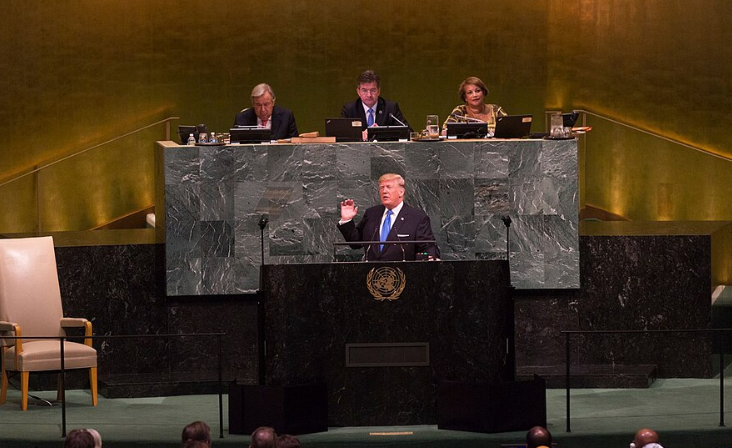
Speaking before world leaders in New York on September 22, Trump argued that military action by the United States and Israel had prevented Iran from developing a nuclear weapon. He also called on other countries to increase economic pressure on Iran and push its government toward an agreement.
Trump said he faced a major decision over whether Iran would reach a deal that would allow the country to rebuild or face further destruction.
According to Reuters, Trump warned that he could "annihilate the Islamic Republic" if Iran refused to reach an agreement ending the conflict.
The comments were among the strongest threats Trump has made against Iran since the conflict began more than six months ago.
The war has disrupted energy markets and shipping routes throughout the Middle East. The Strait of Hormuz has become one of the central issues in negotiations because a large portion of the world's oil supply normally passes through the narrow waterway.
Trump accused Iran of delaying negotiations over reopening the strait and ending the war until after the U.S. midterm elections on November 3.
Despite the harsh language during his U.N. address, Trump sounded more optimistic about diplomacy only hours later.
After meeting British Prime Minister Andy Burnham at the United Nations, Trump said U.S. and Iranian officials were continuing to communicate.
"They want to talk to us," Trump said. He added that Iranian officials had been speaking with the United States that same day and that he believed a settlement would eventually be reached.
Trump said one condition would remain unchanged. The United States would not accept Iran obtaining a nuclear weapon.
Iran also showed signs that negotiations could move forward.
A senior Iranian official said Tehran could reopen the Strait of Hormuz within days if the United States reduced military pressure and lifted its blockade of Iranian ports, Reuters reported.
The competing messages showed the uncertainty surrounding efforts to end the conflict. Trump threatened a major escalation from the U.N. podium while also saying later in the day that talks were making progress.
Iranian President Masoud Pezeshkian and Foreign Minister Abbas Araghchi were in New York for the General Assembly. However, they were not in the hall when Trump began speaking.
Lower-level Iranian representatives attended instead and left about 10 minutes after Trump's speech began, according to The Associated Press.
Trump's remarks on Iran were part of a broader speech that also covered the U.S. economy, immigration, crime, artificial intelligence and several international conflicts.
He opened much of his address by discussing his domestic record before moving into foreign policy.
Trump also denied reports that the war with Iran has caused serious shortages in America's stockpile of advanced weapons.
The Associated Press reported that military experts and U.S. allies have raised concerns about shortages of missile interceptors. NATO officials have described some interceptor supplies as critically low.
Trump also addressed the continuing war between Russia and Ukraine. He said his administration would continue working toward an agreement to end that conflict.
World leaders gathered at the U.N. this year as several wars continue at the same time. Fighting involving Iran, Gaza, Ukraine, Sudan, Congo and Myanmar has placed growing pressure on international institutions.
U.N. Secretary-General António Guterres warned world leaders that military strength alone cannot create lasting peace. He called for greater international cooperation as political divisions continue to grow.
The Iran conflict has become especially important because of its effect on global energy supplies.
Oil prices have remained close to $100 a barrel as traders watch developments in the Middle East. Concerns about shipping through the Strait of Hormuz have contributed to volatility in global markets.
Trump's statements about possible negotiations gave markets some reason for optimism. However, his warning of further military action also raised concerns that the conflict could escalate again.
The president's appearance at the United Nations came during a week filled with meetings involving some of America's most important allies and competitors.
Trump met with Japanese Prime Minister Sanae Takaichi and British Prime Minister Andy Burnham on the sidelines of the General Assembly. He is also preparing to meet Chinese President Xi Jinping in Washington later in the week.
Trump also signed an agreement with Denmark and Greenland that will allow the United States to expand its military presence in Greenland. The agreement followed months of tension over Trump's previous statements about gaining control of the Danish territory.
Still, Iran dominated much of the attention surrounding Trump's U.N. appearance.
The president presented the military campaign as necessary to prevent Iran from obtaining nuclear weapons. Iranian officials have continued to argue that negotiations rather than military pressure are the best path forward.
The next major question is whether the renewed contacts between Washington and Tehran will produce a settlement.
Trump said he believes an agreement will eventually be reached. At the same time, his U.N. speech made clear that he is keeping the threat of additional military action on the table.