

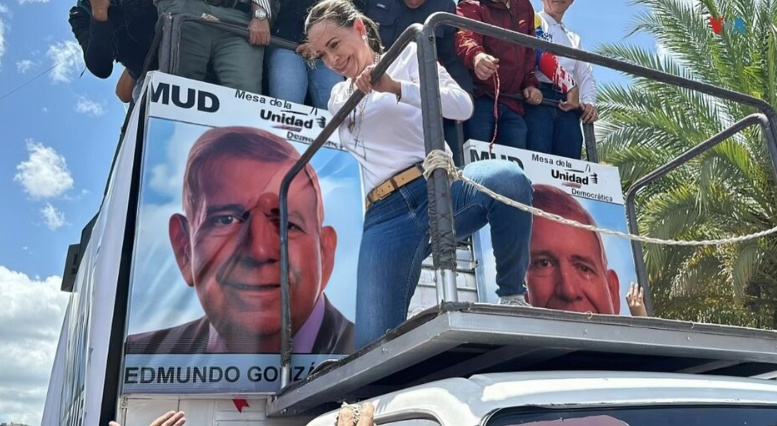
Venezuelan opposition leader María Corina Machado returned to her homeland on Sunday, October 25, 2026, after nearly a year in exile. Her arrival brought thousands of supporters into the streets and renewed demands for presidential elections as the country struggles with an uncertain political transition.
The 2025 Nobel Peace Prize winner appeared in western Venezuela's Lara state, where she visited a church and greeted supporters before traveling toward Caracas.
"I am here. With you," Machado announced on social media.
Her return marks a significant development in Venezuelan politics, nine months after a U.S. military operation removed former President Nicolás Maduro from power. Despite that change, Maduro's former vice president, Delcy Rodríguez, remains in charge of the interim government.
No date has been established for a new presidential election.
Thousands Welcome Machado Back to Venezuela
Machado's return prompted celebrations across parts of Venezuela as supporters gathered along highways to welcome her.
In Lara state, she appeared at the Santa Rosa Church before continuing her journey toward the capital. People sang Venezuela's national anthem and shouted demands for freedom as she passed through.
Reuters reporters witnessed supporters gathering along her route. Some carried Venezuelan flags, while others waited beside highways for an opportunity to see the opposition leader.
In Barquisimeto, 69-year-old Hernán Adames joined the celebrations and expressed hope that Machado would help bring democratic change.
Farther east, supporters gathered in Aragua state as Machado continued toward Caracas.
The crowds demonstrated that Machado retains an active following despite spending much of the previous year outside Venezuela.
Her political movement, Vente Venezuela, has continued organizing opposition activities during her absence. Its supporters have demanded elections and greater political freedoms since Maduro's removal.
Why Machado Left Venezuela
Machado became one of Venezuela's most prominent opposition figures during the presidency of Nicolás Maduro.
She won the opposition's presidential primary in 2023 but was barred from running in the 2024 presidential election. The opposition subsequently supported former diplomat Edmundo González Urrutia.
Venezuelan election authorities declared Maduro the winner of that election. However, the opposition published voting records that it said demonstrated a decisive González victory.
The disputed result triggered protests, arrests and international criticism of the government's electoral practices.
Machado spent much of the following period in hiding amid concerns about her safety and possible arrest.
In late 2025, she secretly left Venezuela and traveled to Norway in connection with receiving the Nobel Peace Prize. The award recognized her work promoting democratic rights and a peaceful political transition.
Her departure ended a lengthy period during which restrictions imposed by Maduro's government had prevented her from traveling abroad.
Although Machado repeatedly expressed her intention to return, several attempts were unsuccessful.
Reuters previously reported that American officials had asked her to delay her return as Washington worked with Venezuela's interim authorities.
How She Returned
Details of Machado's journey became clearer Sunday, although her political team did not publicly describe every part of the operation.
Four people familiar with her movements told Reuters that Machado traveled by private aircraft from Panama to Colombia before crossing into Venezuela overland.
One person briefed on the operation said her return had been coordinated with officials from the United States, Colombia and Panama.
That source also said American security contractors helped protect Machado during her journey. According to the account, Venezuelan authorities were warned not to interfere with her safe return.
These details were reported through unnamed sources, and the governments involved did not independently confirm every element of the operation.
The arrangements reflected concerns about Machado's safety and the sensitive relationship between Venezuela's opposition and its interim government.
Trump Continues Supporting Delcy Rodríguez
Machado's return also drew attention to disagreements over Washington's approach to Venezuela.
Since the U.S. military removed Maduro in January, President Donald Trump's administration has worked with interim President Delcy Rodríguez.
Rodríguez previously served as Maduro's vice president and became interim president following his removal.
Trump has repeatedly praised cooperation with Rodríguez's government, particularly agreements involving Venezuela's oil industry and American companies.
When reporters asked Trump about Machado's return on Sunday, he said he did not know anything about it.
He described Machado as a nice woman but emphasized that his administration was making progress in Venezuela.
His comments differed from an account provided to Reuters by a person familiar with Machado's travel arrangements, who claimed Trump had approved the operation and received updates.
The White House did not immediately respond to Reuters questions seeking clarification.
Secretary of State Marco Rubio offered a more detailed statement about the circumstances surrounding her return.
Rubio credited U.S.-supported reconciliation talks with improving conditions for political opponents, including the release of hundreds of prisoners and the return of opposition figures from exile.
He called on political groups to support negotiations intended to establish conditions for fair elections and lasting democratic institutions.
Venezuela's Election Question Remains Unresolved
The central political dispute now concerns when Venezuelans will be allowed to elect their next president.
Rodríguez told the United Nations General Assembly in September that Venezuela would hold elections as part of a transition toward full democracy.
However, she did not announce a date.
Her interim presidency has also continued beyond the initial period authorized under the country's constitutional arrangements, raising questions about the government's legal and political future.
The Trump administration has argued that Venezuela needs additional preparation before presidential elections can proceed.
Machado and her supporters have taken a different position, calling for a clear timetable and guarantees that opposition candidates can participate freely.
Earlier this month, representatives of the interim government and one opposition faction began discussions about political reforms.
The negotiations have included potential changes to Venezuela's highest court and electoral authorities, institutions that would have important responsibilities during a presidential election.
Machado's political movement has not participated in those talks.
Her return introduces a major opposition figure into the country at a time when negotiations over the political system are already underway.
Opposition Prepares for Future Elections
Machado's supporters are also preparing for the practical challenges of organizing a national election.
Her movement recently introduced an application designed to collect voter registration information from Venezuelans living outside the country.
Reuters reported that a team of 15 people developed the application over approximately 18 months.
The movement hopes that a reformed electoral authority could eventually use the collected information to help eligible Venezuelans register to vote.
Voter registration is a significant issue because millions of Venezuelans have emigrated during the country's prolonged economic and political crisis.
Many live in neighboring Latin American countries, the United States and Europe.
Establishing reliable voter lists and fair participation rules would be important steps toward organizing an election accepted by competing political groups.
Another unresolved issue involves Edmundo González, who represented the opposition in the disputed 2024 election.
González, who has been living in Spain, confirmed Machado's return and said he expected to join her in Venezuela soon.
Their political relationship could become important as opposition groups decide how to approach any future presidential contest.
Economic Recovery Adds Pressure
Venezuela's political uncertainty comes alongside efforts to rebuild an economy heavily dependent on petroleum production.
The country possesses some of the world's largest proven oil reserves, but years of declining investment, economic instability and sanctions have damaged its energy industry.
The interim government has sought agreements with international companies to expand production and attract investment.
In September, several energy firms committed to expanding Venezuelan projects during a ceremony attended by Rodríguez and U.S. Energy Secretary Chris Wright.
Trump has presented economic cooperation as an important part of his administration's approach to Venezuela.
Machado has argued that long-term economic stability requires a government with democratic legitimacy and dependable institutions.
For investors, questions surrounding the country's legal system, political leadership and future elections remain important considerations.
What Happens Next
Machado's advisers say she plans to meet families of political prisoners, members of Venezuela's opposition and representatives of the international community.
She also intends to visit people affected by the deadly earthquakes that struck Venezuela in June.
David Smolansky, her foreign affairs adviser, told Reuters that Machado would work toward securing a date for free and fair presidential elections.
Her return follows nationwide opposition demonstrations on October 22, when protesters called for a transparent presidential vote.
Those demonstrations showed that demands for elections have continued despite changes in the country's leadership.
Several major questions remain unresolved, including whether Machado's movement will join formal negotiations and whether the interim government will announce an election schedule.
For now, Rodríguez remains interim president with Washington's support, while Machado is back inside Venezuela seeking a larger role in determining the country's political future.
The next major development will be whether the government and opposition can agree on electoral reforms and establish a presidential election date.